

More Connection Barriers
March 2026
Our future, the government has decided, fundamentally and throughout all areas of our lives, will depend upon AI and if we are to have a competitive economy we must take steps to facilitate it urgently.
AI requires energy-hungry data centres. How can they connect to the network in any reasonable period of time? How can there be any urgency in play when the connection queue is far greater than the capacity available?
In the connection queue for demand projects, perhaps surprisingly, data centres are the major problem. There are 50GW of data centre applicants, most of which will receive a Gate 2 offer. Of these, about 20GW have achieved FID and are classified as “viable”, with the clear implication that the remainder are “non-viable”.
Ofgem and government are responsible for the viability classifications. They have developed a shared programme to enable “viable” data centre projects to connect earlier and eject the “non-viable” from the connections queue. Their joint enterprise is set out (by Ofgem) in the following, abbreviated, table. (The table has a third column with NESO to facilitate building of networks, something that is only incidental to urgent connections.)
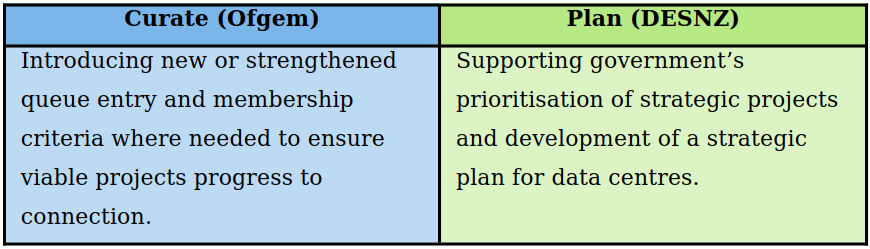
The objectives of this programme are twofold. To reduce the demand queue (by removal of “non-viable” projects) and to develop a plan for data centres (to, inter alia, identify how many we need and where they should be).
Each part of this programme has two combined phases.
Phase 1: Ofgem’s task, “Curate, will put up barriers to queue entry by data centres before reopening of transmission connection applications (due in Q2). The entry barriers include a data-centre specific financial mechanism and the readiness requirements imposed on generation applicants. The task for the DESNZ “Plan” is to develop a strategic plan for data centres and put in place prioritisation mechanisms (the means by which one project – a “viable” data centre - is to be given preferential treatment over others).
Phase 2: Implementation of the DESNZ strategic plan for data centres, involving use of prioritisation measures. Concurrently Ofgem will put in place means to strengthen project commitments and deal with “non-viable” demand projects, i.e., will put up further queue entry barriers if needed.
The new Planning and Infrastructure Act contains the powers (see below) to enable these plans to be achieved.
Changing Industry Documents
There is power to amend certain industry documents to “[improve] the process for managing connections”. Such improvements will, among others, change the order in which connections are made. There will be circumstances in which some projects are pushed ahead of others in the queue, facilitating an earlier (or even a possible) connection date for a preferred project.
The knock-on effect is that non-preferred projects will be in the queue for longer or be pushed back and will, consequently, have a later connection date.
Changing Connection Agreements
There are powers to instruct network companies to modify agreements they have entered into. This has the same intent and effect as changing industry documents.
It means that existing connection agreements can be changed. So a project with a connection offer for 2029 could find that its connection date is later. It could also have further obligations imposed on it.
Designation
DESNZ is given power to designate “strategic” documents. Once designated, network companies must “have regard” them in taking decisions.
One way of reading ‘must have regard to’ is ‘must comply’, even though the obligation is not so expressed. Failure to do so risks judicial review and/or enforcement action by Ofgem.
The Industrial Strategy (and its addenda containing sector specific plans) is to be designated. The plan for data centres DESNZ is to develop is ‘Digital and Technologies’, one of the sector plans. That plan, together with the others, will all be designated and the network companies will need to change their methods to accommodate them.
Once the designation is in place, connection applicants must be prepared to be non-preferred projects.
In addition, the Nationally Significant Infrastructure Projects regime will be amended to include data centres. It appears that individual projects can apply to be included in a NSIP, implying that the NSIP change process will be ongoing.
Other Changes and Their Effects
The Industrial Strategy has selected eight sectors as of key importance. They are Advanced Manufacturing, Clean Energy Industries, Creative Industries, Defence, Digital and Technologies, Financial Services, Life Sciences and Professional and Business Services. Once the Industrial Plan is designated, policy plans for these sectors will also be designated.
In principle any project in these sectors could be selected for preferential treatment; this will not obviously apply only to demand projects.
The upshot is clear. There is currently a vastly over-subscribed connections queue (both for demand and generation). In the generation queue, demand is so great that a proposal has been made (by a developer) to introduce a new barrier to connections by way of an “Oversubscribed Technologies Commitment Fee” on the basis that “there are materially more projects receiving Gate 2 Offers than are “needed”.
Since Gate 2 connection offers are made on the basis a project is “needed”, what is being proposed is that the barriers to all projects, needed or not, should have an even higher hurdle to clear to continue to hold that offer and/or to continue to be “needed”.
The proposed financial hurdle indicates anxiety among developers/investors that their projects may fail for lack of network capacity, whether or not they hold a Gate 2 offer. The proposal is intended to make projects drop out. But upping the financial ante won’t have its intended effect on projects that pass the milestone timetable and which have incurred substantial development costs to get where they are. The ‘barrier’ fee won’t alleviate oversubscription so as to make a connection offer certain enough for certain investment finance.
The anxiety of developers/funders should be sharpened by government’s designation intentions. Designation makes the uncertain even more uncertain. The proposed barrier fee shows clearly how uncertain it is that any generation project can connect on time. When projects identified as designated enter the queue, that uncertainty will become much greater.
Investors might take the risk of a barrier fee, though the reasoning behind it could well make them draw back. But that risk together with the risk introduced by designation might be a risk too far.

More Connection Barriers - March 2026.pd[...]
Adobe Acrobat document [177.7 KB]
 Print
Print